
Uncategorized
What Is 80億分之一? The One-in-Eight-Billion Question
What does 80億分之一 mean? This guide unpacks the Japanese wordplay, the eight-billion scale, the statistics and choices behind the life simulation, and why one random life can still feel uniquely yours.
The short answer
80億分之一 is a Japanese phrase that can be read as “one out of eight billion.” The first part, 80億, means eight billion: in Japanese counting, one 億 is one hundred million, so 80億 is 8,000,000,000. The final part, 分之一, means “one part of” or “one out of.”
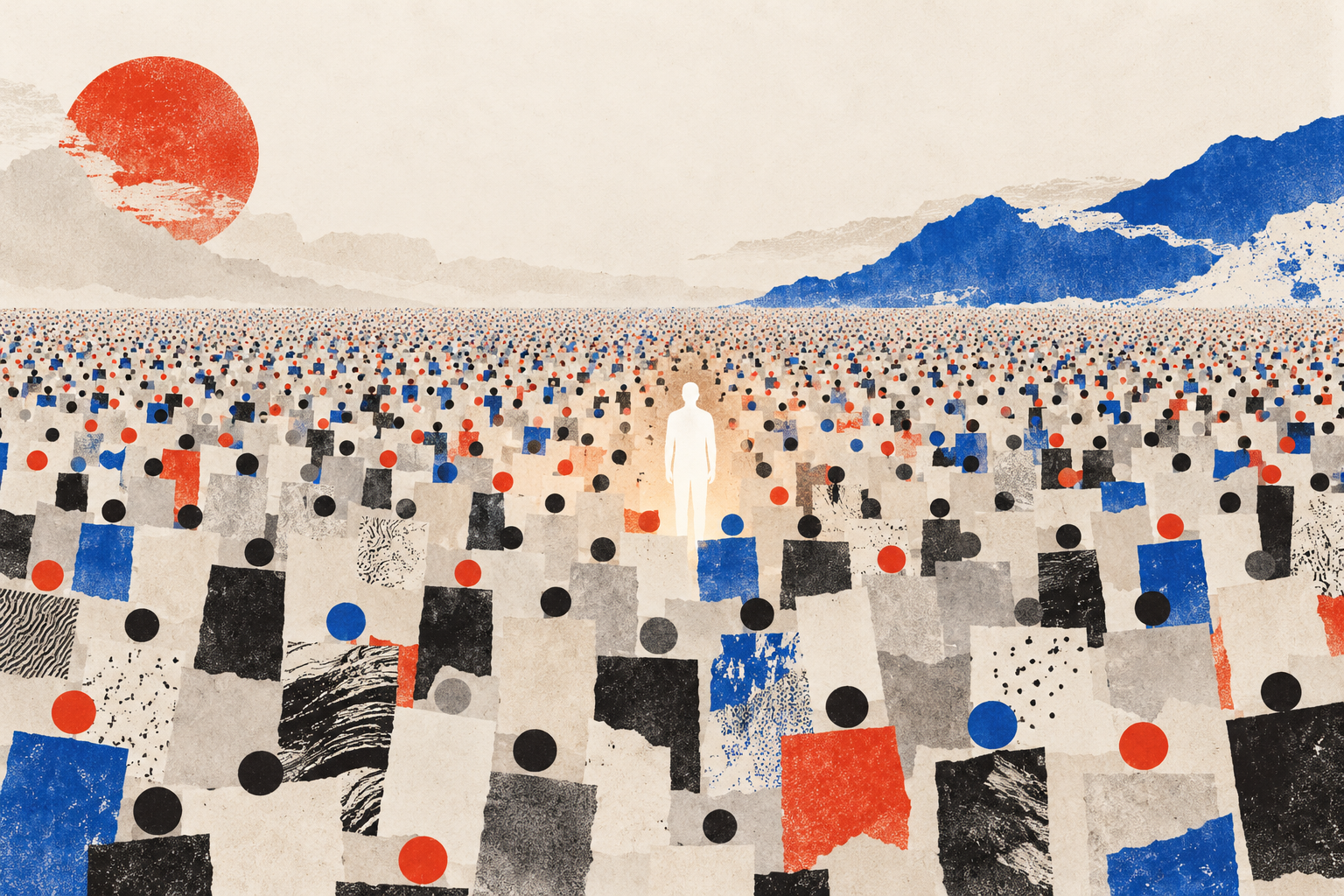
But the phrase is doing more than arithmetic. It turns a population-sized number into a point of view: what would it feel like to be one particular person among billions? That is the question behind 80億分之一, the free browser life simulation.
The game begins with a birth you do not design from a menu. A country, a family situation and an initial set of conditions are drawn from a statistical model. Then the number becomes a life: school, work, relationships, moving, illness, small routines, surprising turns and a final reflection. You can watch the simulation, make decisions, or let the “おまかせ” option carry the story for a while.
This article explains the name, the wordplay, the data model and the reason the experience feels personal even though its starting point is random.
80億 is a scale, not a promise of precision
The phrase sounds exact because it contains a large, clean number. Eight billion feels like a finished denominator, a neat line under a fraction. Real life is less tidy. World population changes every second, population estimates are revised, and no simulation can reproduce every family, city, language, income or relationship on Earth.
That tension is part of the point. 80億 is a human-scale shorthand for “the whole crowded world,” not a claim that every person can be placed into one perfect spreadsheet row. The number helps the mind zoom out. The rest of the experience zooms back in.
Think of it as a board-game box. The box tells you the size of the world; it does not tell you the exact route of the token inside it. The model uses broad patterns such as birth rates, country-level population, education, income, life expectancy and other public statistics. It then turns those patterns into an individual story with enough uncertainty to feel like a life rather than a report.
The wordplay: from fraction to face
The most interesting thing about 80億分之一 is the way a fraction changes grammatical jobs while you read it.
At first, it looks like mathematics:
1 ÷ 8,000,000,000
That answer is tiny. It describes a share, a probability or a proportion. You could write it in a calculator and move on.
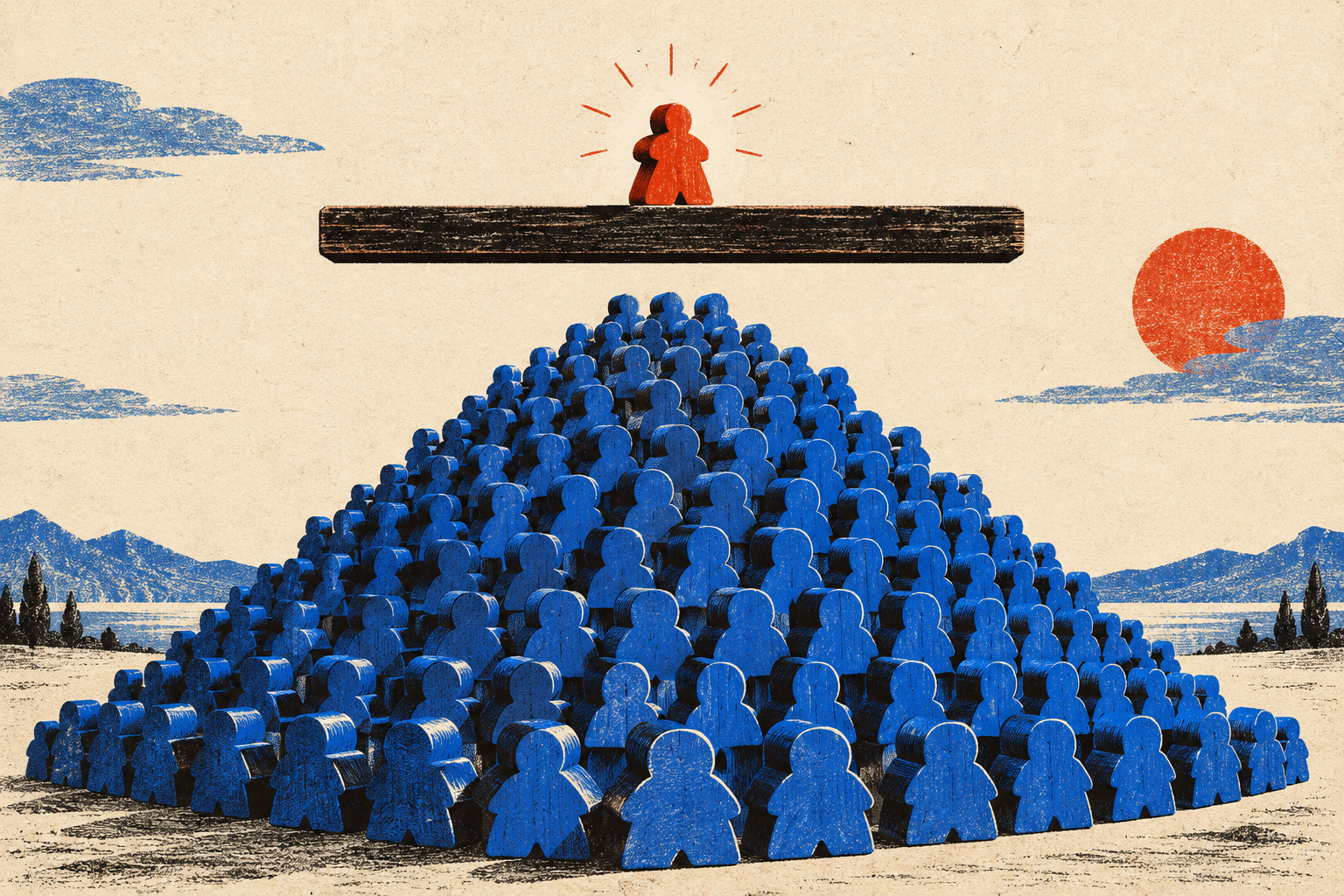
Then the phrase can be heard another way: one person among eight billion. The denominator stops being a wall of zeroes and becomes a crowd. The numerator stops being an abstract “1” and becomes a viewpoint. You are no longer asking how small the fraction is. You are asking what it means for this one life to be located inside the crowd.
That is why the name works as a kind of verbal game. It has a number, a division sign hidden in language, and a sudden change of scale. It begins with “one” as a unit and ends with “one” as a person.
You can describe the transformation like this:
- The number is the board. It gives the experience its planetary scale.
- The denominator is the crowd. It reminds you that every life is surrounded by other lives.
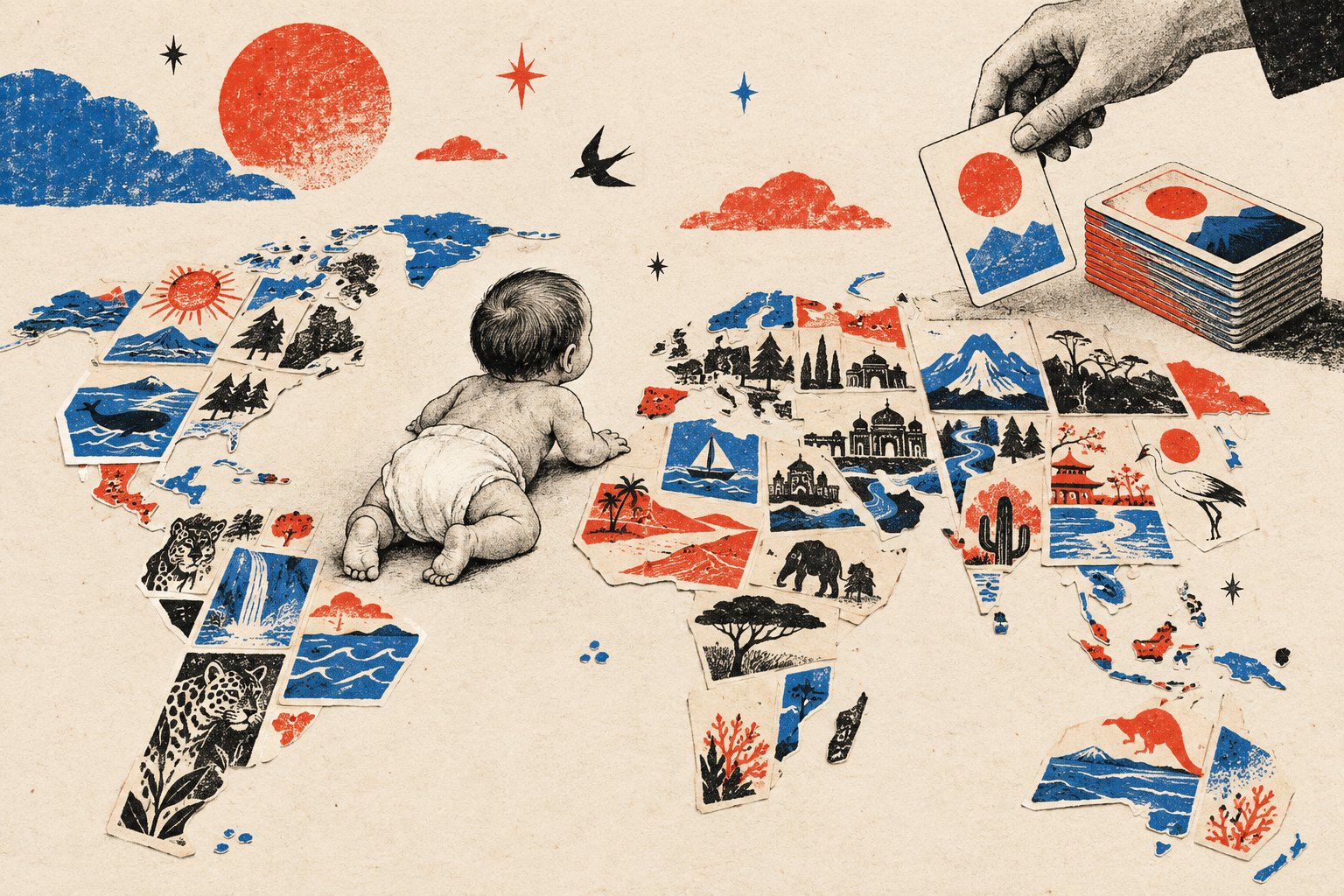
- The random draw is the first move. You start somewhere before you have made a choice.
- The decisions are the verbs. They tell the story what to do next.
- The memory is the punctuation. It gives the finished life a shape you can return to.
The result is not a lesson that every life is interchangeable. It is almost the opposite: the larger the crowd becomes, the more striking it is that a single route can still be noticed, remembered and felt.
What happens when one in eight billion becomes playable?
In a normal game, you often begin with a character sheet. You choose a name, appearance, class, strengths and objectives. The design says, “Here are the tools you have chosen.”
In 80億分之一, the opening question is different: where might this life begin if you did not get to choose the starting line?
The site can use the distribution of current births or the distribution of the living population to decide a birthplace. You can also compare the generated life with the country where you actually grew up, if you choose to enter that information. The comparison is optional and stays on the device; it is not required to play.
The early years are not a test of whether you guessed the right answer. They are a way to notice how many conditions arrive before a person can meaningfully choose anything. Language, infrastructure, family resources, health, safety, school access and local opportunity all alter the menu of later choices. A simulation makes these invisible starting conditions visible enough to discuss.
Random beginning, meaningful decisions
“Random” does not mean “everything is meaningless.” It means the beginning is not a reward for being clever and not a punishment for making a mistake. It is a starting condition.
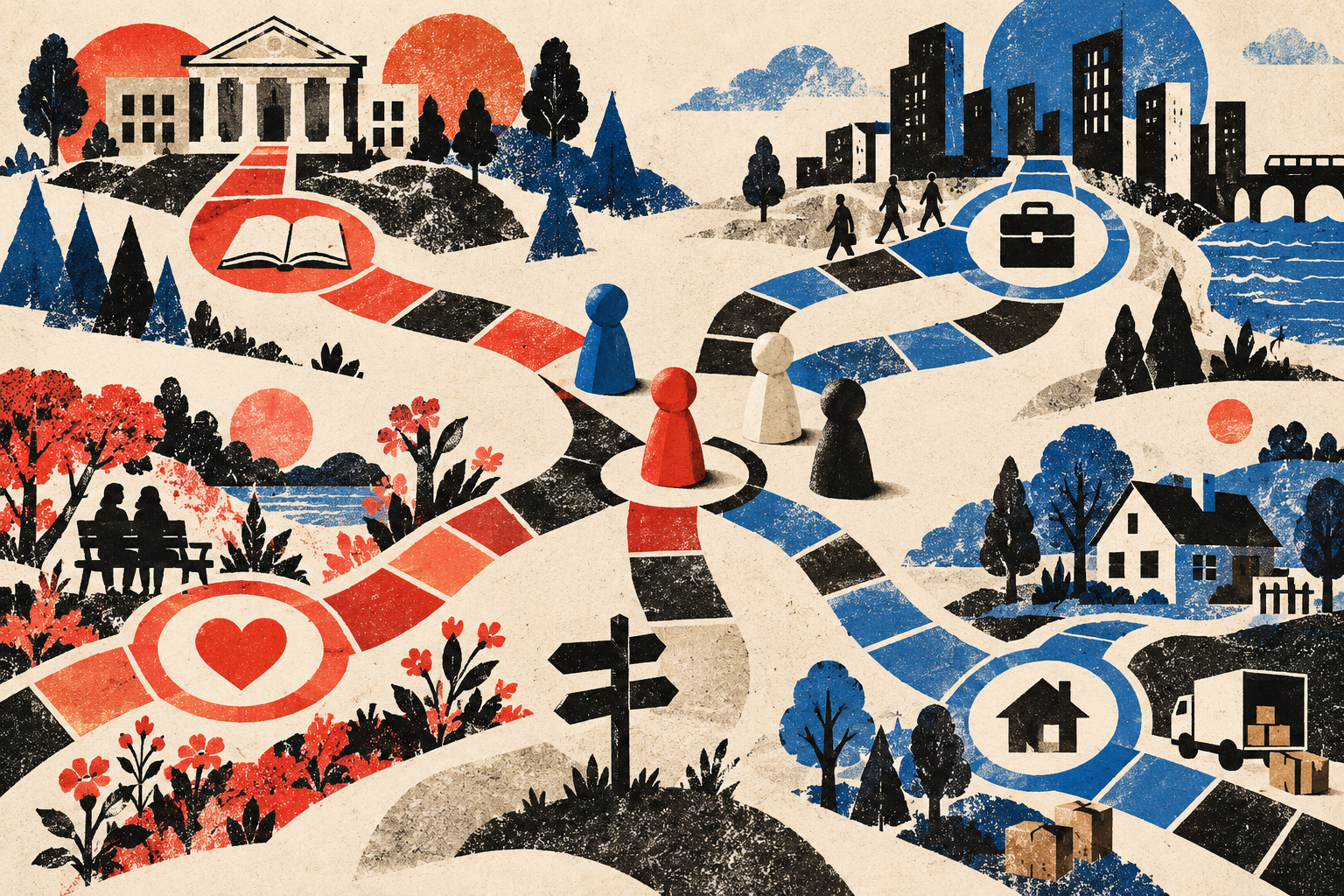
As the life moves forward, the simulation introduces decisions at different kinds of crossroads. You may decide what to focus on at a certain age, whether to study, how to respond to work, whether to move, how to handle a relationship or whether to seek treatment. Some moments are large. Others are deliberately ordinary: a habit, a conversation, a chance to rest, the choice to continue or let the system take over.
This makes the game less like a quiz and more like a reading experience with branching margins. The question is not “Which choice wins?” because real lives rarely provide a visible scorecard in advance. The more useful question is “What kind of person might this choice make room for?”
The option to let the simulation choose for you matters too. It gives you a way to watch the model rather than constantly optimize it. Sometimes the most honest play is to stop treating a life as a puzzle to solve and simply observe how a sequence accumulates into a biography.
Statistics are the material, not the destiny
A high-value life simulation has to explain the difference between a statistic and a prediction. 80億分之一 is built from broad statistical tendencies, but it does not claim to forecast a real person.
The site describes inputs such as country-level birth counts, average life expectancy by sex, under-five mortality, income measured through purchasing-power comparisons, inequality, years of schooling, higher-education participation, agricultural employment, fertility, homicide rates and life satisfaction. Death timing follows broad country- and sex-specific life-table patterns, while causes of death follow simplified age and regional tendencies.
These inputs have three important limitations:
- They are aggregated. A national average cannot tell you what every town, neighborhood or family is like.
- They are rounded and simplified. A game needs a manageable set of rules, while reality contains overlapping identities and exceptions.
- They describe patterns, not an individual’s future. The model can create a plausible route; it cannot declare what will happen to you.
In other words, the numbers are ingredients. The finished story is a constructed experience, not a medical, financial or demographic forecast. This distinction is important because a good simulation should create curiosity about the world without pretending to own the truth about it.

Why a text-based life game can feel bigger than a dashboard
Charts are good at showing distribution. Text is good at showing sequence.
A dashboard might tell you that one country has a certain average life expectancy or that another has a different school-enrollment rate. A text event can make the same difference legible as a moment: a child walking to class, a family deciding whether a move is possible, a worker balancing time and money, a person choosing what to remember.
The writing does not need to describe every event in cinematic detail. In fact, restraint can protect the reader’s imagination. 80億分之一 keeps heavy events such as illness, death, accidents and violence non-graphic, and offers a gentler presentation mode. The goal is not shock. It is recognition: this is a life with constraints, attachments and an ending.
That is also where the “text game” style becomes more than a visual gimmick. Words are the pieces. A short sentence can be a card. A question can be a fork in the path. A repeated phrase can become a motif. By reading and selecting, you are not only consuming the story; you are supplying attention, which is one of the things that turns a statistical route into a remembered route.
A practical way to play
If you want to understand the idea rather than simply read about it, start with one uncomplicated run:
- Open the free life simulation on a phone or computer. No download or account is required for the basic simulation.
- Choose whether to start in the “now,” use the world as a birth distribution, or explore the available starting settings.
- Let the birth happen before trying to judge it. Notice the country, family conditions and the information you were given before any decision appeared.
- At each crossroads, choose deliberately once or twice, then try “おまかせ” and compare the feeling of directing a life with observing one.
- Pause when a question catches you. The point is not to reach the ending as fast as possible.
- When the life is complete, read the summary as a whole. A single choice rarely explains a life; patterns and accumulations matter more.
A full run is designed to fit into roughly thirty minutes to an hour and a half, depending on the selected pace and life expectancy. You can pause and continue later. The basic simulation is free; the optional Memory Pass is for people who want to preserve completed lives across devices and read them like a book.
What is the Memorial?
The Memorial is the place where completed lives can remain visible after their final scene. It is not a leaderboard and it is not a gallery of “best” outcomes. It is closer to a public shelf of anonymous biographies: a place to visit, light a candle and remember that the simulation’s people were not only outcomes.
The site says that a Memorial entry can contain a fictional name, a life summary and an optional final line, rather than your personal contact details. That choice keeps the emphasis on the shape of the life instead of the identity of the player. You can browse the Memorial and meet another finished life before you play, or return to it after your own run.

Frequently asked questions
Does 80億分之一 mean “one in eighty billion”?
No. In Japanese counting, 80億 is eight billion, not eighty billion. The phrase is best explained as “one out of eight billion.” It is also a poetic brand name, so it should not be treated as a promise that the game exactly samples every human being on Earth.
Is the simulation scientifically exact?
No. It uses broad public statistics and simplified rules to create a meaningful, playable model. It is designed for reflection and storytelling, not for research, personal prediction or professional advice.
Can I choose the country where the life starts?
The experience is built around a randomized beginning, but the site offers different world settings and an optional field for your actual birth country so you can compare starting points. The comparison is not required.
Is it a game about winning?
Not in the usual sense. There is no universal “best life” route. You can make choices, allow the simulation to decide, pause, and read the ending as a portrait rather than a score.
Who is it for?
It is for people who enjoy interactive fiction, thought experiments, statistics, quiet games and questions about how much of a life is chosen versus inherited. The site is marked for ages fifteen and up because it can include topics such as illness, death, alcohol, smoking, love and marriage.
How can I send feedback?
The project is in beta and is made with AI-assisted development. If a passage is confusing, a translation feels unnatural or an idea would make the experience more thoughtful, use the contact page to send feedback.
The one sentence to keep
80億分之一 starts with the question “where would one life begin among eight billion?” and ends by asking “what will this life mean when it can be remembered?”
The wordplay is the invitation. The fraction gives you distance; the text gives you texture; the choices give you movement; the ending gives you a chance to look back. You are not proving that one life is more important than the rest. You are practicing the opposite kind of attention: every life is one, and one is already a lot.